

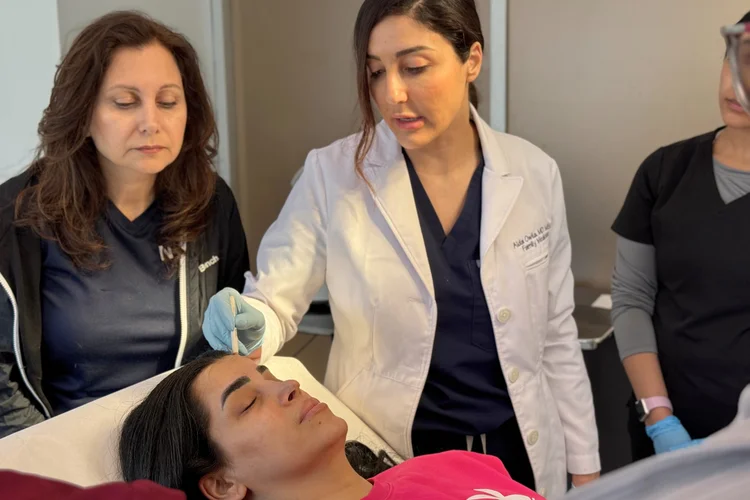
Facial Anatomy Basics Every New Injector Should Know in Canada
By Ahmed Rashed
For every aspiring aesthetic injector in Canada, mastering facial anatomy is essential. Understanding facial structure is not only about precision—it directly impacts treatment safety, natural-looking results, and client trust. Whether you’re performing dermal fillers, neuromodulator injections like Botox®, or PRP treatments, a strong knowledge of facial anatomy forms the foundation of safe aesthetic practice.
In Canada’s regulated aesthetic medicine industry, proper anatomical training is critical for preventing complications and delivering consistent outcomes. Here are the core facial anatomy concepts every new injector should know before treating patients.
- Layers of the Face and Injection Depth
The face consists of multiple anatomical layers, each relevant to different injectable techniques:
- Skin
- Subcutaneous fat
- Superficial Musculoaponeurotic System (SMAS)
- Facial muscles
- Deep fat compartments
- Facial bone structure
Understanding these layers helps determine the correct injection plane:
- Neuromodulators (Botox®) are injected into targeted facial muscles
- Dermal fillers are placed in deep fat compartments or supraperiosteal plane (above bone)
- Skin boosters / PRP are injected superficially within the dermis or subdermis
Incorrect injection depth increases the risk of complications and poor aesthetic outcomes. Canadian injector training programs emphasize depth awareness and needle or cannula control to ensure patient safety.
- Facial Arteries and High-Risk Danger Zones
Certain facial regions carry a higher complication risk due to major blood vessels and nerves. New injectors must thoroughly study:
- Facial artery (along the nasolabial fold)
- Angular artery (nose and medial cheek)
- Supratrochlear and supraorbital arteries (glabella and forehead)
- Infraorbital artery (midface)
- Mental artery (chin region)
Accidental intravascular injection or vessel compression can lead to:
- Vascular occlusion
- Skin necrosis
- Tissue loss
- Vision impairment or blindness
Safe injection protocols taught in Canada include:
- Correct depth selection
- Slow, low-pressure injection
- Aspiration when appropriate
- Small bolus placement
- Continuous anatomical awareness
- Muscles of Facial Expression for Neuromodulators
Neuromodulators such as Botox® work by relaxing overactive facial muscles that create dynamic wrinkles. Key muscles every injector must understand include:
- Frontalis – elevates eyebrows and creates forehead lines
- Glabellar complex – causes frown lines between brows
- Orbicularis oculi – responsible for crow’s feet
- Masseter – used in jaw slimming and bruxism treatment
Knowledge of muscle origin, insertion, and function allows injectors to customize dosing and maintain natural facial movement—an essential expectation among Canadian aesthetic patients.
- Facial Aesthetic Landmarks and Proportions
Achieving natural results requires respecting established facial proportions:
- Rule of Thirds – the face is divided into equal vertical thirds
- Golden Ratio – guides harmonious facial balance
- Midface projection – key to youthful contours
- Chin–lip–nose alignment – supports profile harmony
Aging commonly causes midface volume loss and structural descent. Dermal fillers placed in deep fat compartments and along bone can restore support while preserving facial identity.
Why Facial Anatomy Training Matters in Canada
In Canada’s regulated aesthetic field, improper injection technique can result in medical complications and legal risk. Comprehensive anatomy education helps ensure:
- Patient safety
- Predictable treatment outcomes
- Professional credibility
- Regulatory compliance
- Reduced complication rates
For new injectors, anatomy knowledge is the difference between basic technique and advanced clinical artistry.
Start With Professional Injector Training in Canada
At Chellsey Institute of Beauty & Health, injector certification programs include:
- Detailed facial anatomy education
- Hands-on injectable training
- Safety and complication management
- Canadian clinical protocols
- Supervised patient practice
Your precision begins with knowledge. Learn the face before you treat it.
Frequently Asked Questions (FAQs)
Facial anatomy knowledge ensures safe injection depth, avoids blood vessels, and helps achieve natural-looking results while minimizing complications.
High-risk areas include the glabella, nose, nasolabial fold, tear trough, and forehead due to major arteries that connect to the eye circulation.
Most fillers are injected into deep fat compartments or the supraperiosteal (above bone) layer for structural support and contour restoration.
Common targets include the frontalis, glabellar complex, orbicularis oculi, and masseter muscles to soften wrinkles and improve facial balance.
Injectors are typically licensed healthcare professionals (nurses, physicians, or dentists) who complete accredited injectable training with anatomy education.
It can cause vascular occlusion, leading to skin damage or vision loss. Immediate recognition and treatment with hyaluronidase is critical.
Through cadaver labs, anatomy mapping, supervised injections, and certified aesthetic training programs.